White Cheese
All of TürkiyeMatured in brine, white cheese is a classic of the Turkish table, with balanced salt, a smooth texture and a flavour all its own.


The Cheese Academy, Cheese Atlas, Cheese Guide, Cheese Encyclopedia, Cheese Friends and Cheese FAQ — all on one page.
Cheesemaking techniques, practical tips and learning material.
A detailed look at pasteurisation, whey separation, coagulation, cutting, pressing and maturation.
The use of natural rennet, enzyme sources and traditional culturing techniques.
Maturation over 3 to 12 months, temperature and humidity control, and managing the cheese room.
How cow, sheep and goat milk differ, seasonal effects, and the character of milk from Trakya.
Brining techniques, salt levels, storage conditions and shelf-life management.
Microbiological testing, sensory evaluation and physicochemical analysis.
Traditional cheeses from every region of Türkiye.
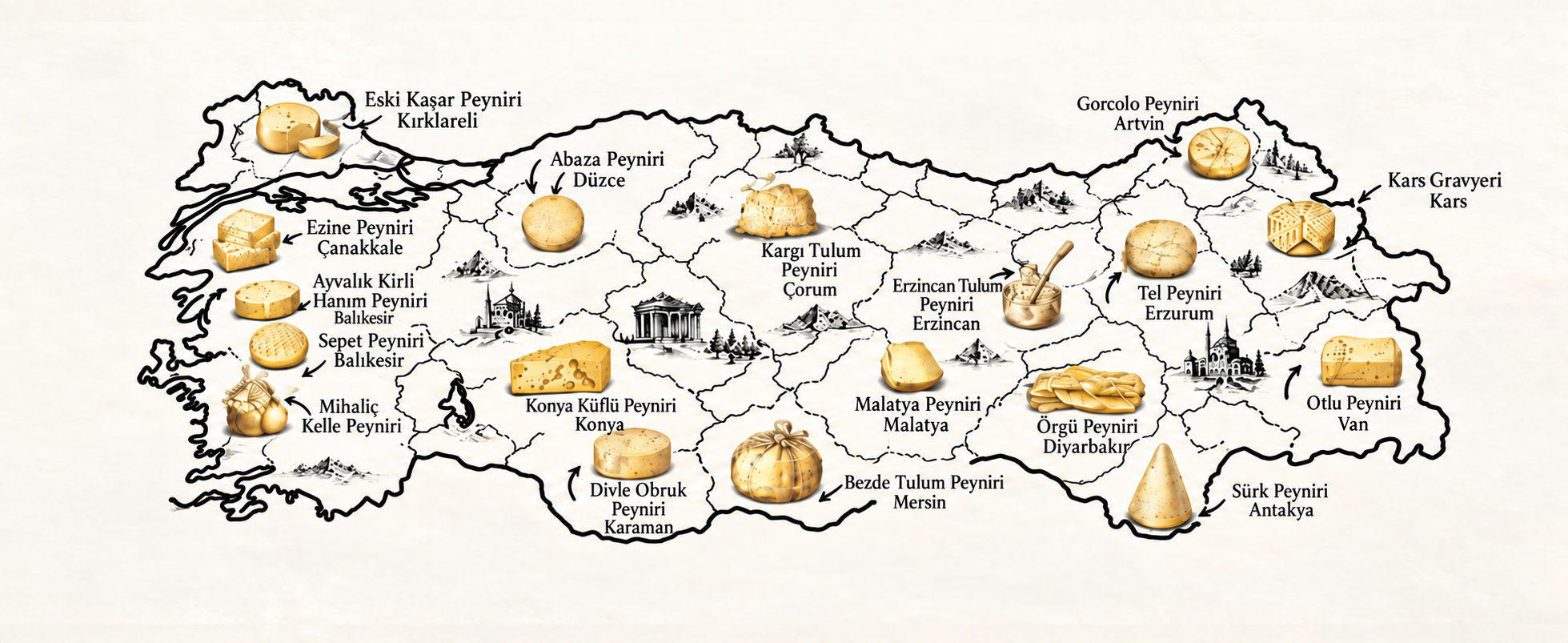
Matured in brine, white cheese is a classic of the Turkish table, with balanced salt, a smooth texture and a flavour all its own.
Made by carefully working the milk, kashar is known for its golden colour and elastic texture. Fresh and matured versions suit a wide range of tastes.
Given its character by traditional maturation, tulum cheese stands out for its intense aroma, distinctive texture and rich flavour profile.
Reflecting the deep cheesemaking tradition of Trakya, kashkaval is characterised by its yellow colour, distinctive aroma and full flavour.
Made from goat milk, this cheese is known for its distinctive aroma and light flavour. Texture and aroma vary with the method of production.
Shaped by a special technique, braided cheese is recognised by its plaited form and slightly elastic texture — a distinctive cheese, ideal eaten fresh.
Made by traditional methods, Mihaliç cheese is firm, pronounced in aroma and mature in character — especially good grated into cooked dishes.
Made from the whey left over during cheesemaking, lor has a mild flavour and soft texture, and is used in everything from breakfast to baking.
Welcome to our guide — for getting to know the world of cheese, discovering different varieties and choosing the right cheese for the right moment.
| Cheese | Pairings | Occasions |
|---|---|---|
| White Cheese | Tomato, olives, bread | Breakfast, menemen, börek |
| Aged Kashar | Olives, tomato, pepper | Breakfast, sandwiches, aperitifs |
| Tulum Cheese | Honey, walnuts, raisins | Special occasions, aperitifs |
| Goat Cheese | Honey, walnuts, fresh figs | Wine pairing, aperitifs |
| Cream Cheese | Salmon, avocado, crackers | Brunch, snacks |
| Mozzarella | Tomato, basil, olive oil | Pizza, salads, gratins |
Cheese takes on different characters according to the type of milk, the method of production, the salting technique, the length of maturation and the conditions it is made in. From soft to hard, from fresh to long-matured, every cheese has its own aroma, texture and place at the table.
Cheeses are generally grouped as soft, semi-soft, semi-hard and hard according to their structure and maturity. This classification varies with moisture content, maturation time and production technique.
Türkiye's rich cheese culture is home to many traditional varieties — white cheese, kashar, tulum, kashkaval, Mihaliç, braided cheese and lor among them.
Maturation plays a decisive role in giving cheese its character. Enzymatic and microbial activity acts on proteins, fats and other components, developing aroma, flavour and texture.
Temperature, humidity and air are controlled to suit each variety. Taciroğlu cheeses are matured under controlled conditions for between 3 and 24 months, depending on the product.
Every cheese has a character of its own. Fresh, soft cheeses suit breakfasts and lighter meals; matured, aromatic cheeses work on charcuterie boards, in salads, in hot dishes and in more adventurous pairings. The right match brings out the flavour of the cheese and adds something new to the table.
A community built for people who love cheese.
A space that brings cheese lovers together under one roof.
Cheese Friends who want to discover new cheeses, see how they are made and learn more about the world of cheese explore it together through special events, expert meet-ups and surprise experiences.
coming soonMaturation time depends on the variety and the method of production. Fresh cheeses reach the table quickly, while matured cheeses can take anywhere from a few months to 24 months.
Cheese should be kept refrigerated, following the storage conditions on the packaging. Once opened, keep it in suitable wrapping or a sealed container to limit contact with air.
Cow, sheep and goat milk can all be used. Depending on the character of the cheese and the method of production, they may be used on their own or blended in set proportions.
Fresh cheeses go to market soon after production and generally have a higher moisture content, a softer texture and a milder flavour. Matured cheeses are held for longer at set temperature and humidity; over that time their aroma, flavour and texture develop and their character becomes pronounced.
Cheese halva is a traditional dessert closely associated with the cuisine of Trakya, made by working cheese together with sugar and other ingredients using traditional methods. Peysan cheese halva is made to preserve that traditional taste.
During maturation, part of the lactose is metabolised by micro-organisms, so some long-matured cheeses can be very low in lactose. Because lactose content varies by variety and production process, anyone with specific dietary needs should check the nutrition information on the label.